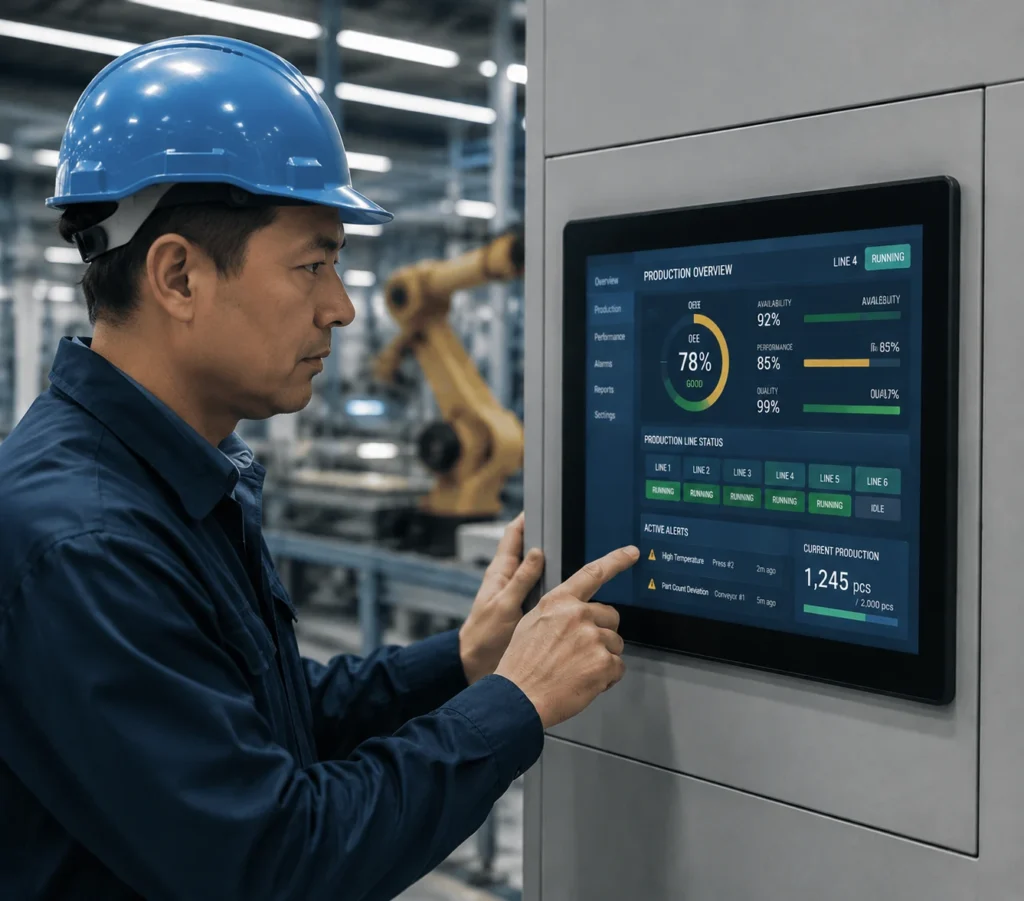
Panel PCs improve smart manufacturing by serving as the real-time interface layer between factory machines and digital control systems. Mounted directly on production equipment, a panel PC running SCADA, MES, or IIoT software collects sensor data at the edge, visualizes KPIs for operators, and feeds production intelligence into ERP systems — all without the latency or reliability risks of cloud-dependent architectures. In Industry 4.0 environments, panel PCs are the physical node where OT data becomes actionable IT insight.
7 Ways Panel PCs Drive Smart Manufacturing
- Serve as the HMI node connecting operators directly to PLCs, sensors, and control systems
- Enable edge computing on the factory floor, eliminating cloud round-trip latency
- Support OPC-UA, MQTT, EtherCAT, and Modbus for universal machine connectivity
- Feed real-time production data into MES, SCADA, and ERP for OEE tracking and optimization
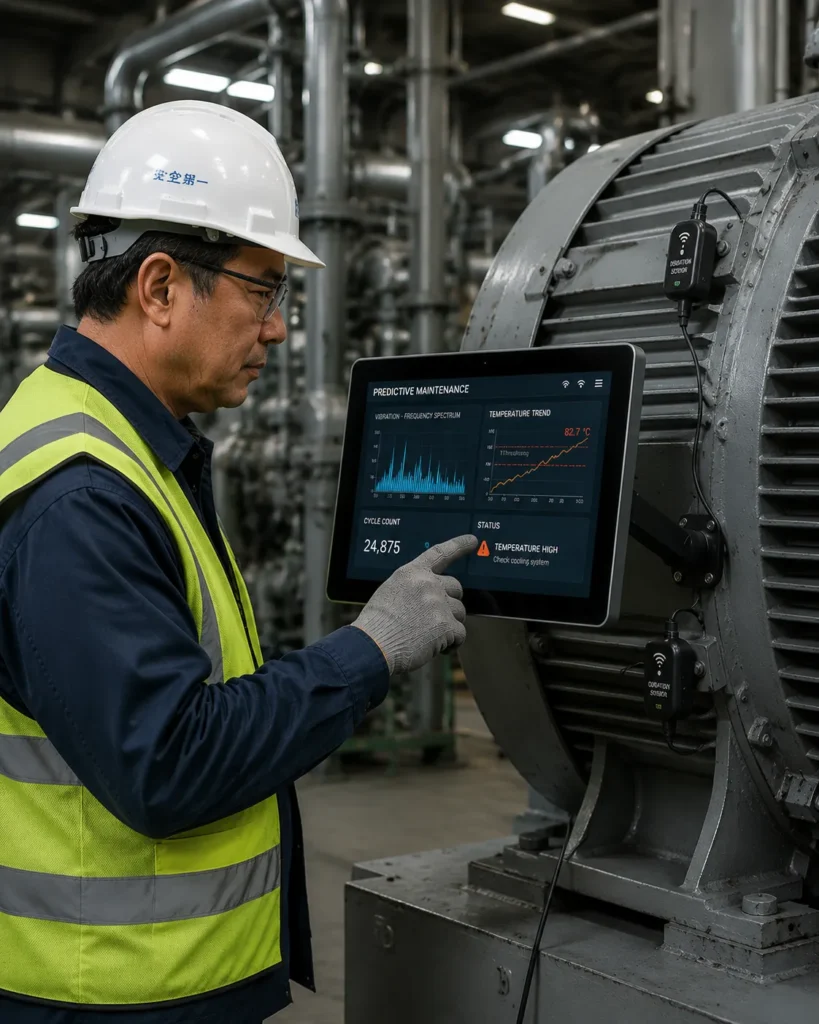
- Enable predictive maintenance by continuously streaming vibration, temperature, and cycle-time data
- Withstand harsh factory environments: IP65+, fanless cooling, -20°C to 60°C operating range
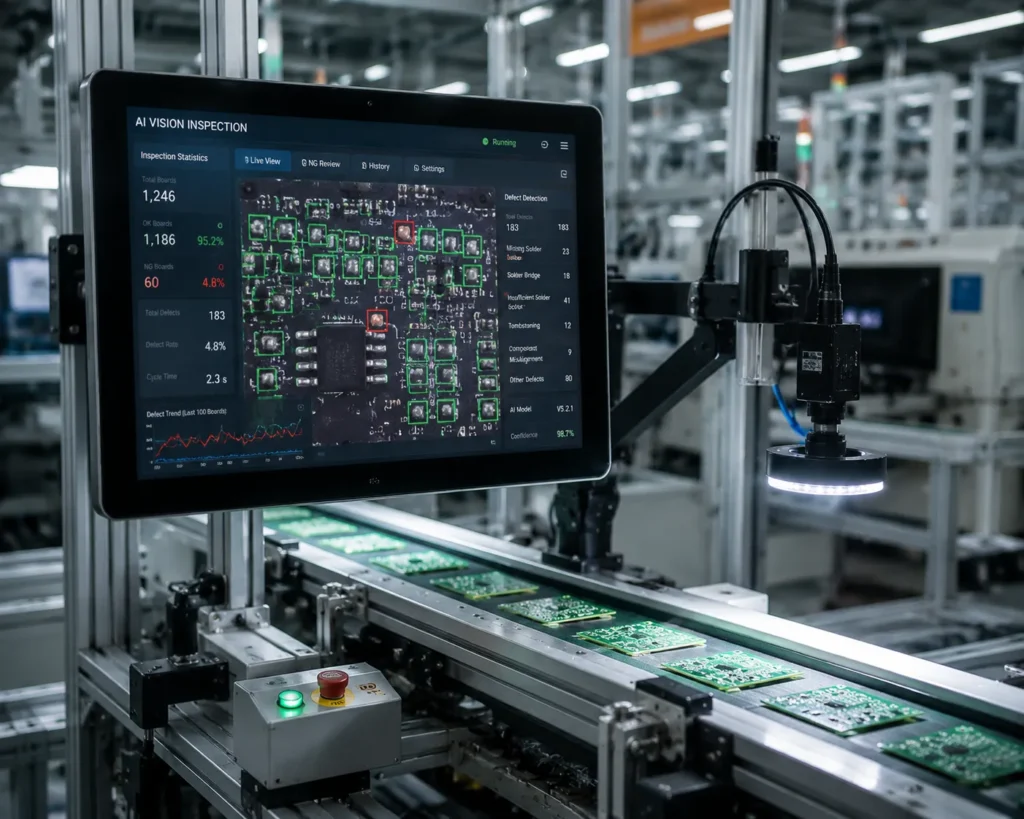
- Run AI inference at the edge for visual inspection, anomaly detection, and quality control
What Is Smart Manufacturing — and Why Hardware Is the Missing Link
Defining Smart Manufacturing in 2026
Smart manufacturing is the deep integration of physical production processes with digital systems — combining IoT sensors, AI-driven analytics, and automated control into a unified operational model. It is the practical realization of Industry 4.0, which rests on four structural pillars: interconnectivity (machines and systems communicating in real time), transparency (a live digital mirror of physical operations), technical assistance (AI and automation supporting human decisions), and decentralized decision-making (edge systems acting autonomously without waiting for central instruction).
According to Priority Software’s analysis of 12 Smart Manufacturing Trends for 2026, AI and agentic systems are now actively monitoring production environments and coordinating across systems with minimal human intervention — a shift that demands reliable, always-on edge hardware at every machine node.
The global smart manufacturing market reflects this urgency. The industrial panel PC segment — a core hardware enabler of smart factory deployments — was valued at USD 5.6 billion in 2025 and is forecast to expand at a CAGR of approximately 7% through 2033, driven primarily by Industry 4.0 adoption across automotive, electronics, food processing, and pharmaceutical manufacturing, according to IMARC Group’s Industrial PC Market Report.
The Hardware Gap in Most Smart Factory Deployments
Most smart factory initiatives invest heavily in software — MES platforms, ERP systems, SCADA suites, and cloud analytics. Yet the physical layer between the machine and these systems is often the weakest link. A conventional office PC or consumer-grade tablet cannot serve this role: it lacks the IP-rated sealing to survive coolant mist or metal dust, cannot operate continuously across -20°C to 60°C temperature swings, offers no guaranteed 7–10 year component lifecycle, and provides none of the industrial communication ports needed to connect to PLCs and field sensors.
This is the hardware gap that a panel PC built for industrial use is purpose-designed to fill. It sits permanently at the machine, operates 24/7 without fan-based cooling, connects natively to both OT field devices and IT enterprise systems, and withstands the physical abuse of a real factory floor — all in a single sealed, touchscreen unit.
The Role of Panel PC in the Smart Factory Architecture
Three-Layer Industrial Architecture — Where Panel PC Fits
Industrial automation systems are organized in three functional layers. Panel PCs occupy the critical middle tier — the edge control layer — where real-time responsiveness meets enterprise data connectivity.
| Architecture Layer | Technology Components | Panel PC Role |
|---|---|---|
| Field Layer | Sensors, actuators, PLCs, servo drives | Panel PC reads PLC signals and sensor streams directly via RS-485, EtherCAT, or PROFINET |
| Edge / Control Layer | SCADA, HMI terminals, edge gateways | Panel PC is deployed here — runs local control software, processes data at the edge, provides the operator interface |
| Enterprise Layer | MES, ERP, cloud analytics, digital twins | Panel PC pushes structured production data upward via OPC-UA and MQTT; receives work orders and scheduling instructions |
Panel PCs sit at the critical middle tier — close enough to machines for sub-10ms real-time response, powerful enough to run the software stack that connects shop floor to enterprise.
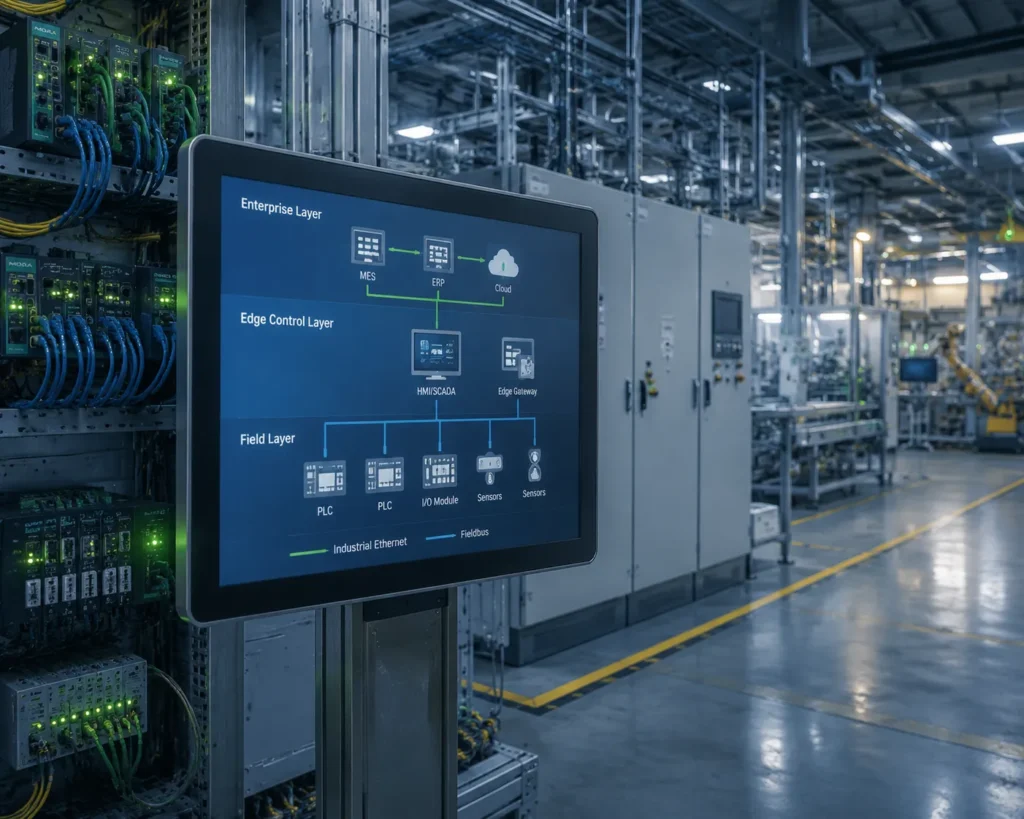
Panel PC as the Central Node of a Digital Factory System
To make this concrete, consider a typical 15-inch panel PC deployment on an automotive assembly line:
- Downward (Field Layer): RS-485 serial connections to 12 machine PLCs monitoring torque, temperature, and cycle count
- Local (Edge Layer): Running Inductive Automation Ignition SCADA with a live OEE dashboard — Availability × Performance × Quality — updated every 500ms
- Upward (Enterprise Layer): OPC-UA client publishing structured production records to the plant MES every minute
- Cloud layer: MQTT messages to Azure IoT Hub for fleet-level analytics and digital twin synchronization
This single device replaces what would otherwise require a separate PLC panel, an HMI terminal, a data logger, and an edge gateway — four devices, four points of failure, four maintenance contracts. For a detailed breakdown of how panel PCs integrate into multi-machine automation architectures, see our Industrial Panel PC Automation Guide.
5 Ways Panel PC Improves Smart Manufacturing
Way 1 — Real-Time HMI and Operator Visibility
Traditional factory operator interfaces — isolated PLC keypads, paper logbooks, or wall-mounted indicator lights — provide no live production picture. A panel PC running modern HMI software transforms this into a real-time dashboard: current machine speed, OEE breakdown, active alarms, batch progress, and quality pass/fail rates, all displayed on a high-brightness touchscreen mounted directly at the point of work.
The shift from resistive to projected capacitive (PCAP) touch technology is particularly significant for operator efficiency. PCAP panels reduce input latency by up to 55% compared to resistive interfaces, enabling faster operator decisions and supporting multi-touch gestures for navigating complex SCADA screens. Operators wearing standard factory gloves can interact without removing them — a practical detail that matters across thousands of daily interactions on a busy production line.
OEE — Overall Equipment Effectiveness — is the primary KPI metric that panel PC HMI systems make visible in real time. Calculated as Availability × Performance × Quality, OEE quantifies exactly how productively a machine is being used. When an operator can see OEE drop from 87% to 71% the moment a micro-stoppage begins, they can intervene before the batch is compromised rather than discovering the problem during end-of-shift reporting.
For a detailed comparison of panel PCs against dedicated proprietary HMI terminals — including protocol support, software flexibility, and long-term cost — see our Panel PC vs HMI analysis.
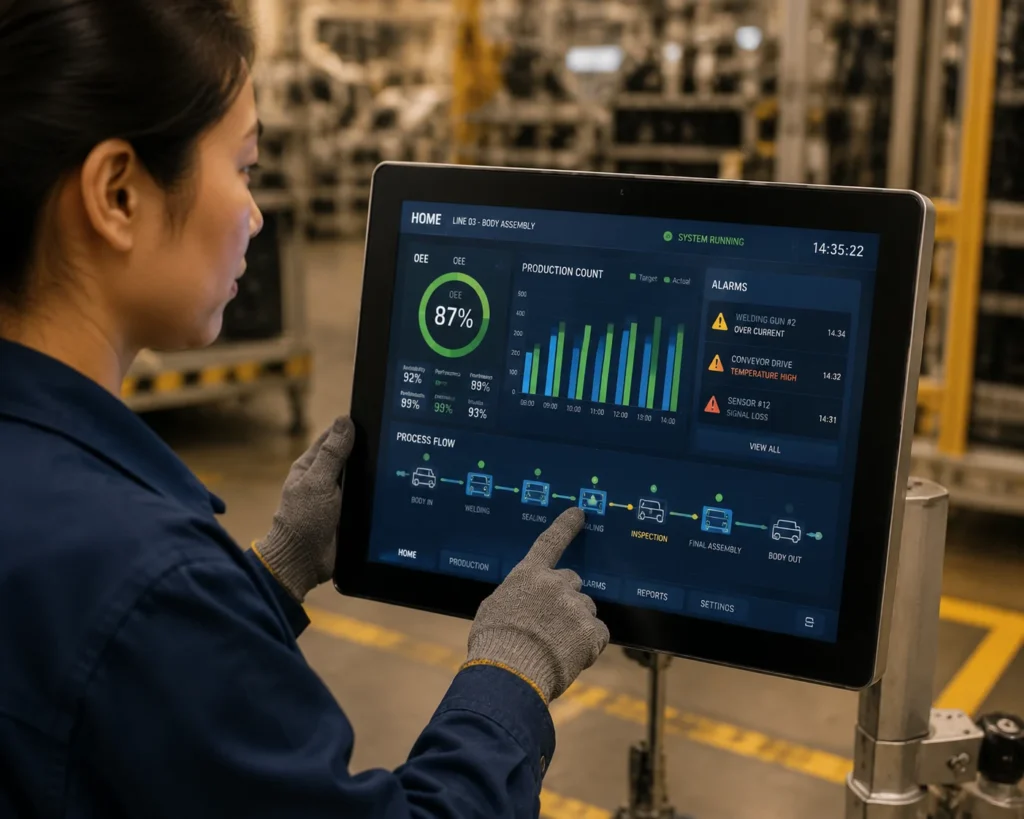
Way 2 — Edge Computing and IIoT Data Processing on the Factory Floor
Edge computing in a factory context means processing machine data locally — at or near the equipment — rather than routing it to a remote data center or cloud platform before acting on it. For time-sensitive manufacturing processes, this distinction is not academic: cloud round-trip latency of 100–300ms is operationally incompatible with processes that require sub-10ms response times, such as servo motor synchronization, real-time quality gating, or safety interlock control.
A panel PC functions as the IIoT edge node in this architecture. It runs analytics software, protocol conversion, and AI inference directly on the shop floor, producing decisions and alerts locally while selectively forwarding aggregated, structured data to higher-level systems. The result: faster response, lower bandwidth consumption, and continued operation even during network outages.
| Processing Architecture | Response Latency | Bandwidth Load | Network-Down Operation |
|---|---|---|---|
| Cloud-only processing | 100–300 ms | High (raw data upload) | ❌ System halts |
| Panel PC edge-only | < 10 ms | Low (local only) | ✅ Fully autonomous |
| Edge + Cloud hybrid | < 10 ms local / cloud for analytics | Средний | ✅ Optimal resilience |
According to the IBM Institute for Business Value Edge Computing Report, organizations classified as “Edge Disruptors” — those deploying edge computing comprehensively across operations — expect 23% ROI within three years, compared to just 3% for peers who delay edge adoption. In manufacturing, the combination of IIoT-enabled panel PCs and edge computing is a direct driver of this outperformance.
Over 67% of new manufacturing automation systems deployed in 2024 incorporated panel PCs with embedded IIoT gateways, up from 41% in 2021 — a 26-point increase that reflects the industry’s recognition of the panel PC as the standard edge IIoT node.
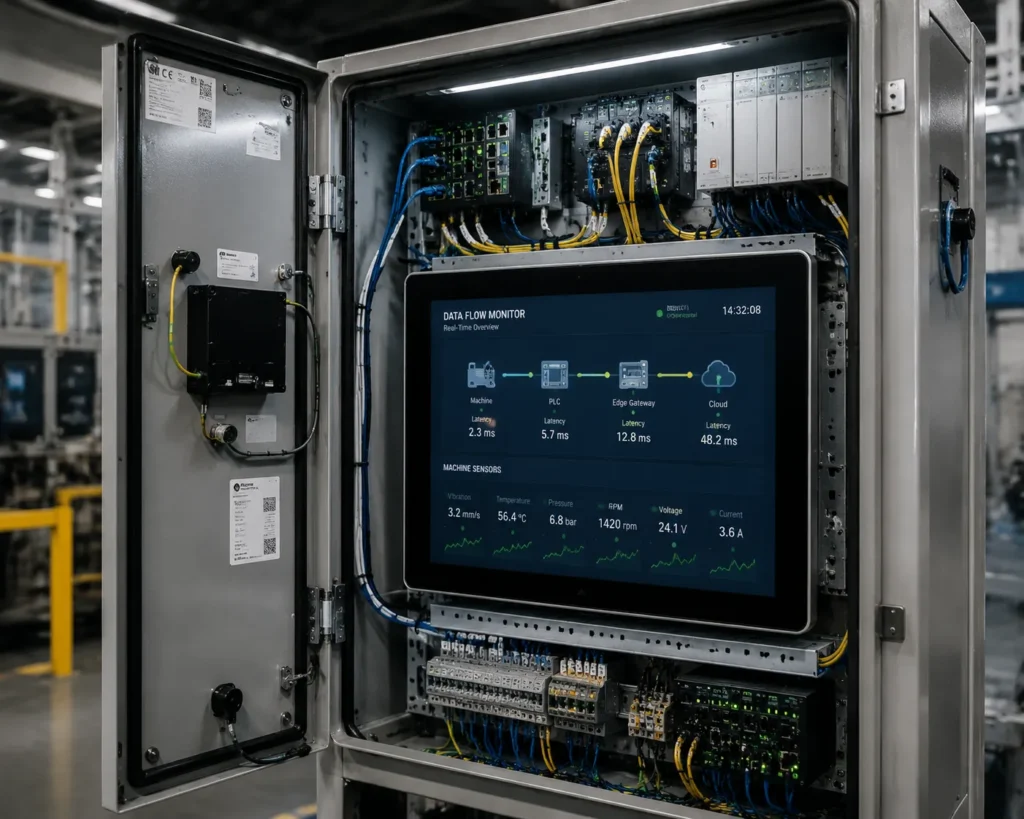
Way 3 — Seamless Integration with MES, SCADA, and ERP
The production value of a panel PC extends far beyond what is displayed on its screen. The device is the physical convergence point of OT (operational technology) and IT (information technology) — the layer where machine signals become structured business data.
This integration is built on a layered communication protocol stack:
| Protocol | Function | Layer |
|---|---|---|
| OPC-UA | Semantic data exchange between SCADA, MES, ERP — vendor-neutral, secure | OT → IT primary bridge |
| MQTT | Lightweight publish-subscribe messaging to cloud platforms | Edge → Cloud |
| Modbus RTU/TCP | Connection to legacy PLCs and instrumentation | Field → Panel PC |
| EtherCAT | Real-time deterministic control for motion systems | Field → Panel PC |
| PROFINET | Siemens-ecosystem machine networking | Field → Panel PC |
As Advanced Tech’s OPC-UA technical guide explains, OPC-UA is rapidly becoming the preferred standard for data exchange throughout manufacturing — linking PLCs to SCADA systems, and SCADA to MES and ERP, all through a single semantically-rich, security-enabled protocol layer. A panel PC running an OPC-UA server becomes the native data publisher for the entire machine cell.
The practical workflow is: machine PLC → Panel PC (OPC-UA server, local SCADA running) → plant MES (production order tracking, OEE calculation) → ERP (inventory, scheduling, quality records). This eliminates the manual data entry that plagues plants still relying on paper travellers or isolated PLC data historians, replacing it with continuous, structured, auditable data flow. To understand how these connectivity trends are evolving through 2026 and beyond, see our Industrial PC Trends 2026 overview.
Way 4 — Predictive Maintenance and Reduced Unplanned Downtime
Unplanned equipment downtime is the single largest source of productivity loss in discrete manufacturing, typically costing between USD 50,000 and USD 250,000 per hour depending on the production line. Panel PCs address this directly by enabling predictive maintenance — the continuous monitoring of machine health parameters to detect anomaly patterns before they become failures.
A panel PC connected to a machine via its industrial I/O continuously streams:
- Vibration frequency and amplitude — bearing wear and imbalance signatures
- Motor temperature curves — insulation degradation and overload indicators
- Current waveform patterns — mechanical load changes and electrical faults
- Cycle time drift — tooling wear and feed rate degradation
- Production counter data — maintenance interval triggers based on actual usage
Machine learning models or rule-based anomaly detection engines run locally on the panel PC, analyzing these streams in real time and generating maintenance alerts before parameters reach failure thresholds. This transition — from reactive maintenance (fix after failure) to predictive maintenance (act on early warning) — is one of the most quantifiable ROI drivers in Industry 4.0 implementations.
A peer-reviewed study published in NCBI / PubMed on predictive maintenance platforms in smart manufacturing documents how real-time sensor data acquisition and local analytics — precisely the functions a panel PC performs — enable the timely detection of anomalies and scheduling of maintenance based on actual equipment condition, extending machine lifespan while reducing both downtime and maintenance cost. In a 2024 multi-factory pilot involving 12 facilities, plants deploying IIoT-gateway-equipped panel PCs with local anomaly detection achieved a 28% reduction in unplanned downtime compared to baseline.
For vertical-specific case studies showing how panel PCs enable predictive maintenance in automotive, electronics, and food processing environments, see our Panel PC Applications in Factory Automation guide.
Way 5 — Smart Factory Control Through AI and Vision at the Edge
The most significant 2026 development in panel PC smart manufacturing is the arrival of AI-native panel PCs — devices that integrate dedicated Neural Processing Units (NPUs) or Vision Processing Units (VPUs) directly into the panel PC chassis, enabling real-time AI inference without a separate GPU server or cloud API call.
At Embedded World 2026 in Nuremberg, NEXCOM launched its APPC C21-01 AI-Edge fanless panel PC series under the theme “Unleashing the Ingenuity of Software-Defined Edge Computing.” These devices provide a direct bridge between industrial automation and intelligent data processing — running AI inference models for quality inspection, defect detection, and production anomaly recognition locally, with no cloud dependency.
Practical applications of AI-edge panel PCs in smart factory control include:
- PCB solder joint inspection: High-resolution camera feeds processed by on-device AI detect bridging, insufficient solder, and component misalignment at production speed — replacing standalone vision system servers costing 3–5× more
- Robotic guidance and pick-and-place optimization: Real-time object pose estimation enables adaptive robotic arm control without external vision processing hardware
- Production rhythm prediction: AI models trained on cycle time, energy consumption, and upstream sensor data predict emerging throughput bottlenecks and alert production managers before queue buildups cascade into line stops
- Energy optimization: Panel PC AI continuously adjusts machine operating parameters to minimize energy consumption within quality tolerance bounds — directly supporting factory sustainability targets
This convergence of panel PC and AI-edge computing is not a future concept — it is shipping hardware in 2026, and it defines the next capability tier for smart manufacturing control systems.
Key Features That Make Panel PCs Built for Smart Manufacturing
Industrial-Grade Ruggedness: The Foundation of 24/7 Operation
No amount of software capability matters if the hardware fails. Industrial panel PCs are engineered for continuous operation in environments that destroy consumer electronics within days:
- IP65–IP69K ingress protection, classified under IEC 60529 — the international standard governing enclosure protection against solid particles and liquid ingress. IP65 provides dust-tight sealing and protection from water jets; IP69K covers high-pressure, high-temperature steam washdown
- Fanless passive cooling — heat dissipation through the aluminum chassis eliminates the most common mechanical failure point. MTBF ratings of 50,000–100,000 hours translate to 7–11 years of continuous 24/7 operation
- Wide operating temperature: -20°C to 60°C standard; -40°C to 70°C for extended-temperature models deployed in outdoor, cold storage, or foundry environments
- MIL-STD-810G vibration and shock certification for vehicle-mounted or press-adjacent deployments
- Optical bonding on the touchscreen assembly eliminates the internal air gap between glass layers — preventing condensation, improving impact resistance, and enhancing readability in high-ambient-light environments
Connectivity Arsenal: Bridging OT and IT
| Interface | Application | Supported Protocols |
|---|---|---|
| RS-232 / RS-422 / RS-485 | Legacy PLC and sensor connection | Modbus RTU, custom serial |
| Dual GbE LAN | Factory network and isolated control network | OPC-UA, PROFINET, EtherNet/IP |
| USB 3.x | Local data access, barcode scanner, external storage | — |
| WiFi 6E / 5G (modular) | Wireless IIoT connectivity, AGV/forklift mounting | MQTT over 5G, WiFi 6 |
| CAN Bus | Vehicle and heavy equipment control | CAN 2.0A/B, CANopen |
| HDMI / DisplayPort | Secondary display output | — |
| M.2 / Mini-PCIe | AI accelerator module, additional wireless, SSD | — |
| Digital I/O (GPIO) | Direct machine signal input/output | — |
Software Compatibility for Digital Factory Systems
A panel PC running the wrong OS or an unsupported software version becomes a liability in a smart factory — updates that break SCADA compatibility can halt production. Industrial panel PCs address this through long-term OS support commitments:
- Windows 10 IoT Enterprise LTSC 2021: End of support October 2032 — the standard choice for SCADA-dependent deployments requiring OS stability
- Windows 11 IoT Enterprise LTSC 2024: 10-year support, compatible with next-generation MES and ERP interfaces
- Ubuntu 22.04 LTS / 24.04 LTS: For open-source SCADA (OpenSCADA) and ROS-based robotics integration
Compatible SCADA and MES platforms include Siemens WinCC, Inductive Automation Ignition, Rockwell FactoryTalk View, AVEVA System Platform, and SAP Manufacturing Execution. OPC-UA server capability is available natively on all major platforms, enabling panel PCs to publish structured data to any compliant upstream system.
Industry Applications of Panel PC in Smart Manufacturing
Panel PCs are deployed across virtually every industrial vertical. The following represent the highest-density application segments, based on YLWWPC’s deployment experience and market data. For a full application overview across verticals, visit the YLWWPC Application Gallery.
Automotive Assembly Lines
Panel PCs mounted flush to assembly jigs serve as the primary operator interface for torque data visualization, error-proofing (Poka-Yoke) prompts, and real-time assembly sequence guidance. Each station’s panel PC connects to the torque tool controller via RS-485 or EtherCAT, records fastening data against the vehicle VIN, and pushes traceability records to the plant MES every cycle. Siemens SIMATIC HMI systems — among the most widely deployed in global automotive OEM plants — are designed around this panel PC architecture.
When a torque value falls outside specification, the panel PC locks the assembly station and triggers an operator alert before the vehicle moves to the next station — converting what would have been a warranty claim into an in-station correction.
Electronics and PCB Manufacturing
SMT (Surface Mount Technology) production lines use panel PCs for cycle time monitoring, first-pass yield tracking, and increasingly, in-line AI-assisted visual inspection. Per data published in the ISA (International Society of Automation) blog on leveraging shop floor data, automotive electronics lines track cycle time, robot health, and assembly pass/fail counts as primary OEE inputs — all collected and displayed through panel PC HMI systems.
AI-edge panel PCs on SMT lines can compare solder paste deposition images against golden reference models at production throughput, flagging defect-risk boards before reflow — reducing scrap and rework cost without slowing the line.
Food and Beverage: Traceability and Regulatory Compliance
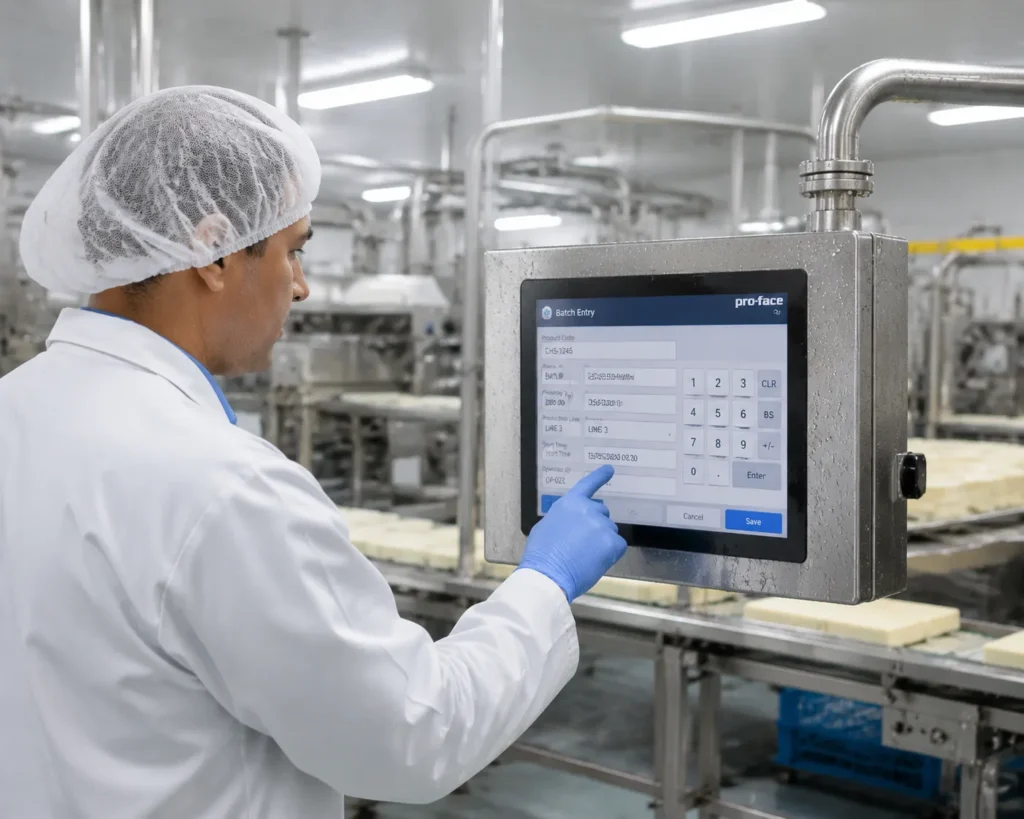
Food processing environments require hardware that can withstand daily high-pressure washdowns with caustic cleaning agents — a demand that eliminates consumer PCs entirely and makes IP69K-rated stainless steel panel PCs the only viable option.
Beyond hardware survivability, panel PCs in food manufacturing enable the end-to-end batch traceability required by FDA regulations and EU food safety frameworks: recording recipe parameters, ingredient lot numbers, processing temperatures, hold times, and operator IDs against each batch in real time. When a quality issue arises, the traceability record is complete, accurate, and instantly retrievable — versus reconstructing events from paper logs hours or days later. For specific food and beverage panel PC deployment examples, see the YLWWPC Application page.
Pharmaceutical and Medical Device Manufacturing
GMP (Good Manufacturing Practice) environments impose strict requirements on how production data is collected, stored, and audited. Panel PCs running software compliant with FDA 21 CFR Part 11 — which governs electronic records and electronic signatures in pharmaceutical manufacturing — provide the complete audit trail that regulatory inspections require.
The fanless design of industrial panel PCs is particularly important in pharmaceutical cleanrooms: no fan means no airflow that could distribute particulates, and no fan filter to trap them. Combined with smooth-surface IP69K front panels that clean without crevices, panel PCs integrate naturally into Class C and Class D cleanroom environments where equipment surfaces must meet strict hygiene standards.
Logistics and Warehouse Automation
In automated distribution centers and manufacturing logistics areas, panel PCs serve as scanning, weighing, and routing control terminals — the human-facing interface to WMS (Warehouse Management Systems) and automated conveyor and sortation systems. Each station’s panel PC connects to barcode scanners, RFID readers, and conveyor PLCs while syncing in real time with the WMS for inventory location, pick confirmation, and shipping label generation.
The evolution toward autonomous mobile robots (AMRs) and automated storage and retrieval systems (ASRS) in 2026 is expanding the panel PC’s logistics role into fleet management dashboards and AMR dispatch interfaces. For a forward-looking view of how these trends are reshaping industrial PC deployment, see our Industrial PC Trends 2026 analysis.
How to Choose the Right Panel PC for Your Smart Manufacturing Setup
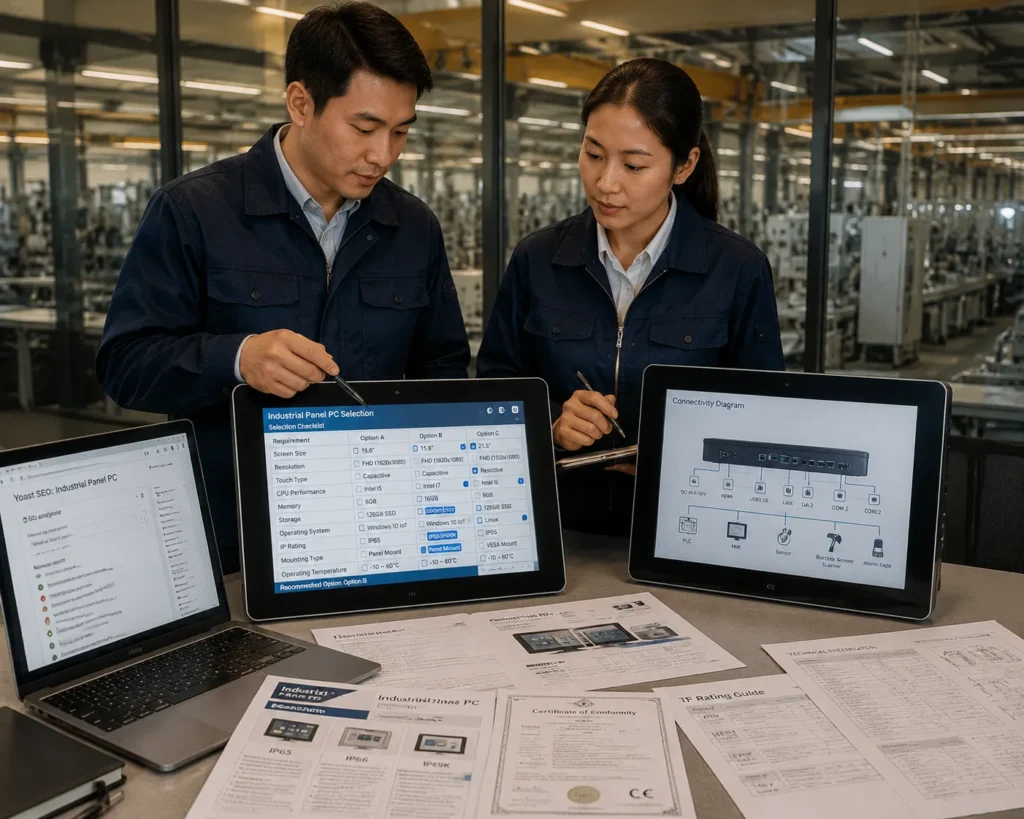
Selecting the wrong panel PC for a smart factory deployment is a common and costly mistake — one that typically surfaces 12–18 months into the project when hardware limitations block the next software upgrade or an environmental failure causes unplanned downtime. Use this five-step framework to align hardware selection with your actual operational requirements.
Step 1 — Define the edge workload
The CPU platform requirements vary dramatically by application:
- Light-duty HMI and SCADA visualization → Intel Core i3 or i5 mobile platform (15W TDP) is sufficient; fanless thermal design is straightforward
- Machine vision, real-time image processing → Intel Core i7 (28W TDP) with dedicated GPU or integrated vision processing; confirm camera interface (USB3 Vision, GigE Vision) support
- Edge AI inference (defect detection, anomaly recognition) → Intel Core Ultra with integrated NPU, or platforms supporting ONNX Runtime and Intel OpenVINO
- Multi-axis motion control with RT requirements → confirm real-time OS (RT Linux, Windows TwinCAT) compatibility before hardware selection
Step 2 — Match IP protection to the deployment zone
- Metal cutting, machining, or welding environments: IP65 minimum — dust-tight and water jet protected
- Food processing, beverage filling, pharmaceutical washdown: IP69K stainless steel — high-pressure, high-temperature steam cleaning
- Cleanroom (pharmaceutical, semiconductor): fanless + smooth front panel + IP54 or IP65 depending on cleaning protocol
- Indoor logistics or light assembly: IP54 aluminum panel mount is typically adequate
All IP ratings are classified under IEC 60529 — verify the rating applies to the front panel specifically, not just the overall enclosure.
Step 3 — Confirm IIoT protocol support
Before purchasing, verify the panel PC platform can natively run (not just pass through) the following:
- OPC-UA server (built-in, not requiring a separate license server)
- MQTT client for cloud or broker-based messaging
- The specific fieldbus your machines use: EtherCAT, PROFINET, EtherNet/IP, Modbus TCP, or CAN Bus
- Number of RS-232/485 COM ports ≥ number of legacy devices requiring direct serial connection
Step 4 — Verify software and OS lifecycle compatibility
Confirm that your target SCADA or MES software — WinCC, Ignition, FactoryTalk, AVEVA — is certified on the OS version the panel PC ships with. Choose Windows IoT Enterprise LTSC over standard Windows for the 10-year support commitment. If the plant uses SAP ME or Siemens Opcenter for MES, verify the panel PC OS is on the supported client list. For deeper guidance on operating systems and integration options for industrial panel PCs, see What Is an Industrial Panel PC.
Step 5 — Evaluate long-term lifecycle TCO
Ask prospective suppliers directly:
- What is the guaranteed component availability period for this platform? (Minimum acceptable: 7 years; target: 10 years per Intel’s embedded processor roadmap commitment)
- Is the hardware BOM (Bill of Materials) version-locked — i.e., will a component change require re-certification testing?
- What is the documented MTBF, and under what operating conditions was it measured?
- Is there a spare parts stocking program for end-of-life units?
Smart Manufacturing Panel PC Selection Checklist
Before finalizing procurement, verify all of the following:
Front panel IP rating meets or exceeds the deployment zone requirement (IP65 / IP69K)
CPU platform supports the target workload (HMI / Vision / AI inference)
OPC-UA server, MQTT client, and target fieldbus protocols are natively supported
OS version is compatible with all target SCADA and MES software licenses
Manufacturer provides ≥ 7 years of component supply availability commitment
MTBF documentation provided and ≥ 50,000 hours
Certifications verified: CE, FCC, relevant IP rating, RoHS, and any industry-specific (MIL-STD-810G, ATEX, UL)
Touchscreen type confirmed: PCAP for gloved operation or resistive for wet/stylus environments
Panel PC vs Traditional Industrial PC in Smart Factory Control
For deployments where the choice between an all-in-one panel PC and a modular box PC + display combination is open, the following comparison frames the decision in the context of smart factory control requirements specifically:
| Decision Dimension | Panel PC (All-in-One) | Box PC + Display (Modular) |
|---|---|---|
| Deployment complexity | Low — single device, minimal cabling | High — video signal, USB touch, power cabling |
| Edge computing performance | Mid-high: mobile Core i7, 28W TDP | High: desktop CPU, GPU expansion via PCIe |
| HMI response latency | Fast — display and compute co-located, no signal cable delay | Moderate — cable-introduced latency, possible display sync issues |
| IIoT interface integration | Unified — COM, LAN, WiFi, GPIO all built in | Modular — may require add-in cards for complete I/O |
| Environmental protection | IP65–IP69K front-of-panel sealed | Cabinet-dependent — compute unit protected; display rated separately |
| Maintenance approach | Single unit — minimal touch points | Independent replacement of compute or display module |
| Smart factory deployment priority | ✅ Machine-level HMI nodes, operator stations | ✅ High-performance compute, control room, multi-screen |
For a full technical comparison including protocol support, display specifications, and TCO analysis, see Panel PC vs HMI: Which Is Right for Your System?
The Future of Panel PC in Smart Manufacturing — 2026 and Beyond
AI-Native Panel PCs: From HMI Terminal to Intelligent Edge Agent
The panel PC’s role in smart manufacturing is expanding beyond visualization and data relay. The integration of NPUs directly into panel PC platforms — demonstrated at Embedded World 2026 by NEXCOM and others — marks the transition from passive HMI terminal to active intelligent edge agent. A panel PC with an integrated NPU can run trained neural network models for quality inspection, energy optimization, and production scheduling locally, with no GPU server, no cloud API dependency, and no latency penalty.
This capability is particularly significant for mid-size manufacturers who cannot justify the capital cost of dedicated AI servers at every production cell, but who need the accuracy and throughput of machine learning-based quality control. The AI-edge panel PC delivers both — at panel PC pricing, in a panel PC form factor, with panel PC-grade environmental protection.
5G Connectivity and Time-Sensitive Networking (TSN)
Two infrastructure technologies are reshaping how panel PCs connect within the smart factory. First, 5G private networks enable panel PCs to operate wirelessly at full IIoT connectivity — AGV-mounted panel PCs, forklift terminals, and mobile operator stations can maintain sub-5ms latency connections to plant systems without Ethernet tethering. Second, Time-Sensitive Networking (TSN) — an IEEE 802.1 standard extension — enables deterministic, low-jitter Ethernet with guaranteed delivery windows below 1ms, making it suitable for hard real-time control applications previously requiring proprietary fieldbuses like PROFIBUS or DeviceNet.
As Priority Software’s 2026 manufacturing trends analysis documents, 5G integration for real-time connectivity is among the top structural trends reshaping smart manufacturing operations this year — and the panel PC is the hardware endpoint through which this connectivity reaches the operator and the machine.
Digital Twin Integration at the Machine Level
Digital twins — virtual models that mirror physical assets in real time — require a continuous, high-fidelity data feed from the physical asset they represent. Panel PCs are emerging as the primary data source for machine-level digital twins: they collect the sensor streams, cycle data, quality outcomes, and operating parameters that define a machine’s current state, and publish them in structured OPC-UA format to platforms like Siemens Xcelerator, PTC ThingWorx, or Azure Digital Twins.
The practical outcome is a continuously updated virtual replica of each machine on the factory floor — one that maintenance engineers can query, simulate against, and use for failure prediction without physically accessing the equipment. The panel PC’s role in this architecture is foundational: without a reliable, protocol-fluent edge node at each machine, the digital twin is built on incomplete or delayed data.
FAQ — Panel PC and Smart Manufacturing
Q1: What role does a panel PC play in smart manufacturing?
A panel PC serves as the real-time interface and edge computing node between shop-floor machines and digital factory systems. It collects sensor and PLC data locally, runs HMI and SCADA visualization, and transmits structured production intelligence to MES and ERP systems — functioning as the physical bridge between OT (operational technology) and IT in an Industry 4.0 environment. In panel pc smart manufacturing deployments, this device is typically the single most important piece of hardware at each machine station.
Q2: How does a panel PC support IIoT in a factory?
Panel PCs support IIoT by natively running OPC-UA servers, MQTT clients, and industrial Ethernet protocols including EtherCAT and PROFINET. They collect data from field devices, process it at the edge, and publish structured data streams to cloud platforms or on-premise MES systems — without requiring a separate edge gateway device. This makes the panel PC a self-contained IIoT node, reducing system complexity and single points of failure.
Q3: Can a panel PC replace a traditional PLC HMI in a smart factory?
Yes, in most applications. Panel PCs running open-platform SCADA software such as Inductive Automation Ignition, Siemens WinCC, or Rockwell FactoryTalk View offer substantially greater flexibility, local data storage, and enterprise connectivity than proprietary PLC-integrated HMI panels. They are particularly well-suited to smart factory control environments that require MES integration, multi-protocol communication, and software upgrades without hardware replacement.
Q4: What is edge computing in a factory, and how does a panel PC enable it?
Edge computing in manufacturing means processing sensor and machine data locally — at or near the equipment — rather than routing raw data to a remote cloud server for analysis. A panel PC enables edge computing by running analytics software, AI inference models, and protocol conversion directly on the factory floor, delivering decisions and alerts in under 10ms without cloud latency or dependency. This capability is essential for real-time quality gating, safety interlocks, and process control.
Q5: How does a panel PC reduce downtime in smart manufacturing?
By continuously monitoring machine parameters — vibration, temperature, cycle counts, current draw — and running predictive maintenance algorithms locally, a panel PC detects equipment anomaly patterns before they become failures. This shifts maintenance from reactive (post-failure repair) to predictive (condition-based intervention), reducing unplanned downtime. Multi-factory pilot studies document reductions of 20–30% in unplanned downtime in plants deploying panel PCs with integrated IIoT gateway and local anomaly detection capabilities.
Q6: What software does a panel PC run in a digital factory system?
Panel PCs are compatible with the full stack of industrial software: SCADA platforms (Siemens WinCC, Inductive Automation Ignition, AVEVA System Platform), MES interfaces (SAP Manufacturing Execution, Siemens Opcenter), OPC-UA servers for structured data publishing, and edge AI frameworks including ONNX Runtime and Intel OpenVINO. They run Windows 10/11 IoT Enterprise LTSC for long-term OS support stability — the appropriate OS choice for digital factory system deployments with 7–10 year operational lifecycles.
Q7: What IP rating is required for a panel PC in a manufacturing environment?
The required IP rating depends on the deployment zone. IP65 — dust-tight and protected against water jets — is the baseline for most factory floors, machining environments, and light assembly areas. IP69K — rated for high-pressure, high-temperature steam washdown — is mandatory for food processing, beverage production, pharmaceutical manufacturing, and chemical processing environments. IP ratings are defined by IEC 60529, the official international standard published by the International Electrotechnical Commission.
Q8: How long do panel PCs last in continuous smart factory operation?
Industrial panel PCs with fanless thermal designs are engineered for 50,000–100,000 hours MTBF — equivalent to 7–11 years of continuous 24/7 operation. Intel’s embedded processor roadmap guarantees component availability for up to 10 years for industrial-grade Core platforms, ensuring hardware platform stability across the full smart manufacturing deployment lifecycle.